Whataroa


One of my favorite pictures taken in New Zealand’s South Island is of me, talking to two older men in a driveway. One of them in gumboots, the other in flip flops. Both of them were dragging their feet through the gravel, when the photo was snapped, trying to draw a map to the house where my grandfather may, or may not have, grown up in.

My husband took the photo of me from the passenger seat of our rental car, a vehicle loaded up with camping gear, sleeping bags, two hiking packs and his fly-fishing gear, a cooler and just enough clothes to get us through the three weeks we were there. I had left the car running.

The porch of the Whataroa Hotel.

We were in Whataroa – a town smaller than where we lived in Montana. When we stopped at the town hotel – which like all towns around here, doubles as the local pub – the windows were thrown open and pillows had been placed on the sills to air. The paint on the porch was peeling. The sign for Speights beer was faded. The sitting chairs out the back where we sat looked like old church hall seats that were torn. The yellow stuffing showed through the slits.

This was the town that my father’s father, Jim Hyndman, had grown up in, leaving for another farming community in the North Island where he met my grandmother, Gwyneth Griffith at a dance at the town hall. Jim died when my father was 15, leaving the Waikato sheep farm in Kiwitahi to my father’s older brother to run, while my father left for Australia, and then London to work in motorsport. Dad met my mother there. They ended up in California – her oceany homeland – where I was born. New Zealand became a fairytale, faraway land to my father’s children. A place in framed photographs across the carpet from the hallway closet until we were old enough to experience it for ourselves.

The Hyndmans were descendants of the Gunn family, who ran this as a boarding house in the 1890s through the 1920s because it was on the main route down the West Coast. That route now runs through farmland.
The house in the 1920s.

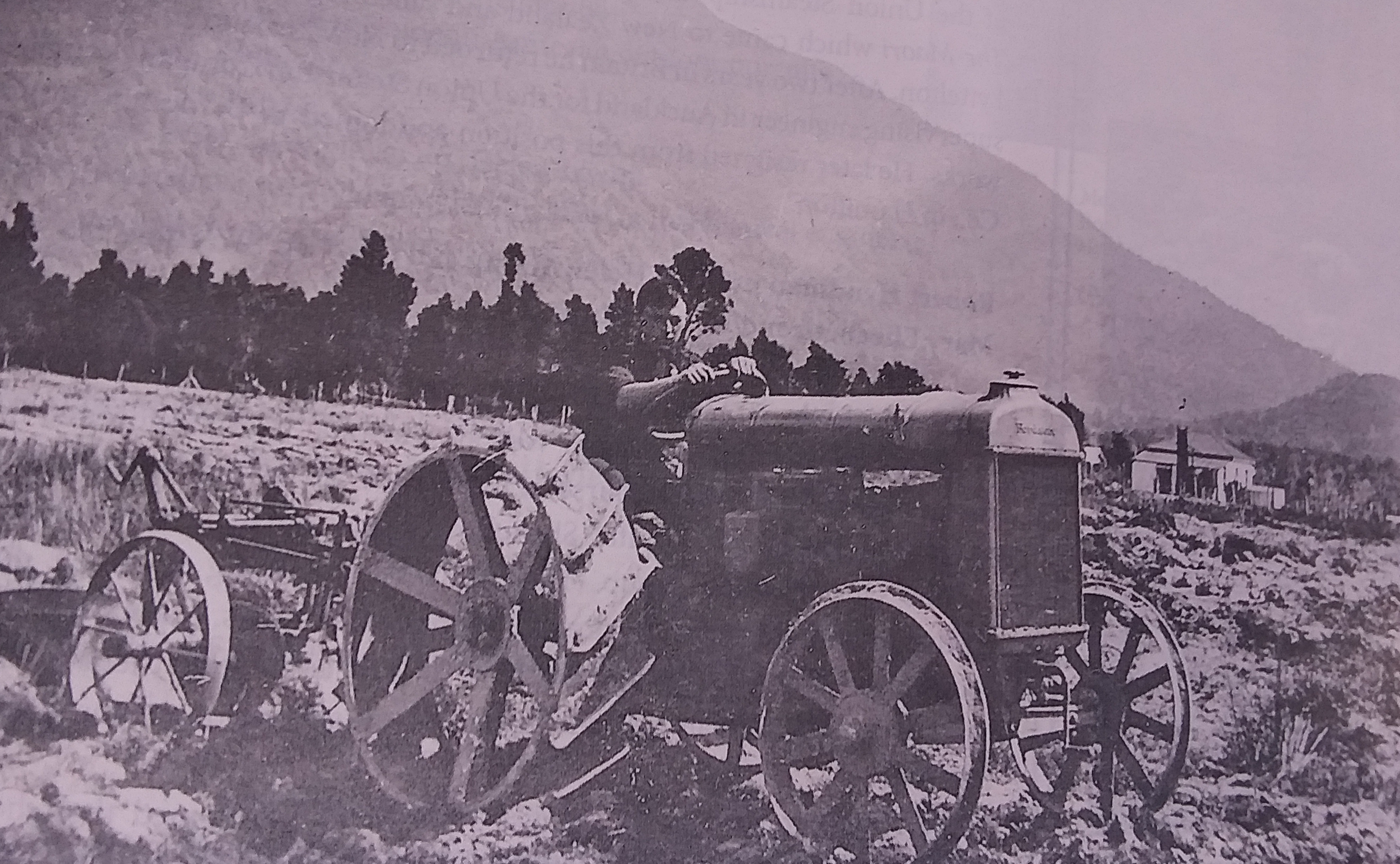
His memories, and my own, are of the farm in Kiwitahi, which stayed in the Hyndman family until my uncle and aunt retired more than ten years ago. The tiny town on the battered west coast of the South Island where Grandpa Jim had been raised was only known to us in old photographs. One was of the home in the 1890s, horses and a coach pulled up in front. Then in a faded, fuzzy photo in the 1920s, when it was still used as a boarding house. Another was of Grandpa Jim in a paddock, with the Hyndman home behind him, probably taken sometime in the 1930s. In this photo he was on a tractor and the mountains behind him were dense with native trees and bush. My father told me that this was the first tractor in this region of the West Coast, something I’ve never probed the accuracy of. It’s too cool a story to mess with. He remembers that the tractor went with Jim to the North Island and that it became a piece of playground equipment at the local school.

When I worked for a South Island-based hiking company, we would drive through this area on our way to coast and I’d point out the old family farm to clients. I always planned on one day coming back through this place. I’d have a beer at the pub. Maybe go take a picture of the old homestead. They might even let me inside for a look.

And this was the afternoon to finally do this, with John beside me.  I pulled into the driveway I had been pointing out to people through the years, without being able to stop myself. I had saved a photo of Grandpa Jim on the tractor and of the Hyndman boarding house in the 1920s onto my phone.

Two brothers and their families were there in the sun on the front steps and listened while I explained myself. A barbecue was going on somewhere. Nineties rock was on. I could smell sunscreen. I was there to take a photo of the house that my grandfather had lived in, if that was fine with them, I said, feeling like I was a journalist again, apologizing as I was trespassing.One of the wives listened in, a hand over her eyes to block the late afternoon light. I could tell she would have invited us to stay for tea if I had lingered much longer.

They were friendly, but perplexed. They remembered the Hyndmans, they said, but as far as they remembered, the Hyndmans had lived on the adjacent property, not theirs. The brothers  looked at the photos I showed them. Yes, one of them said. That’s the Hyndman house, but that’s on the other end of the road, where the highway used to go through and is now closed to through traffic. Look at the treeline, one of them said, holding up the photo of my grandfather on the tractor. Just like he pointed out in the photo, the wild bushland that went straight up behind us had a clear treeline and it was no where near where we were standing in their driveway.

A booted toe dragged a line through the gravel, hands pointed, and there was lots of talking over each other as the brothers discussed the best way I could get to the old homestead. It was still occupied, they said, and was one of the oldest standing houses in the community.

I got in the car, disoriented. It’s weird to have a piece of your family history all backwards, then explained back to you by a stranger who lives with that history in their backyard. Were the brothers wrong? Could there be more than one Hyndman house, as is common in farming families. Maybe my dad or I had looked at the map backwards or upside down. I wondered how that had happened as we drove back through Whataroa and to the other end of the same gravel road, following the directions they had given me, an eye on the treeline that defined the property below.

The old house was falling apart. When I walked towards what seemed to be the front, lined with boots and jackets, I could see that all the doors were open. I called out “hello?” – a few times, but all I heard was a few familiar strains of a song I couldn’t place at first. A strumming guitar. A few blurred minor keys. Then Bowie’s voice set the definitive tone for this sojourn into my family’s past in this place. My feet actually went step by step up to the top of the porch to the front door to a that haunting countdown, a searing, psychedelic guitar strain, then Check ignition and may God’s love be with you. I stopped when I saw a lone vacuum cleaner in a vast lounge room with just one lounge chair and a flatscreen television. Someone was in house. Maybe they were just in the shower. Maybe behind a parted curtain. But everything felt wrong and weird and I didn’t want to be standing on those front steps anymore, like the first victim in some indie horror film.

I walked back down to the car, turning around to take pictures with my phone, definitely in retreat. I didn’t know what to make of this house. It was definitely the workers’ quarters for an adjacent farm now. If this homestead had glory days, they were long gone. It felt like a run-of-the-mill, decrepit house that you’d see in any old town that you’d drive through and just think creepy.

It’s funny how ordinary history is – and how missable – when it isn’t in a framed picture in your family’s hallway. My dad contends that the brothers got it wrong. That the Hyndman house was on their property after all. Was it the foundation that their newer house had been built on in the 1970s? I just think my dad and I need to come back to this place and get to the bottom of this mess, so we can get our story straight. But this is why you take these side trips – to get a better idea of how your own lineage descends through the tree on a piece of paper. Sometimes it’s drawn for you in the gravel of a driveway.

New Skin


It’s like a new skin of an old self that I’ve returned to.

Sitting on sunken couches, under windows with cobwebs triangling the corners. Waves, wind rain; a door-stop of a book opened in my lap, unread past the first paragraph. Walking barefoot to the shower outside and standing there under the heat, the plastic curtain pulled back, the wind chimes going, watching the sea and flax, as rainwater batters the tin roof. The sound of the tea jug boiling on the gas burner when I get back to the main crib. The smell of toast and salt air and sea mold is deep in the walls.  That’s the skin I’ve returned to.

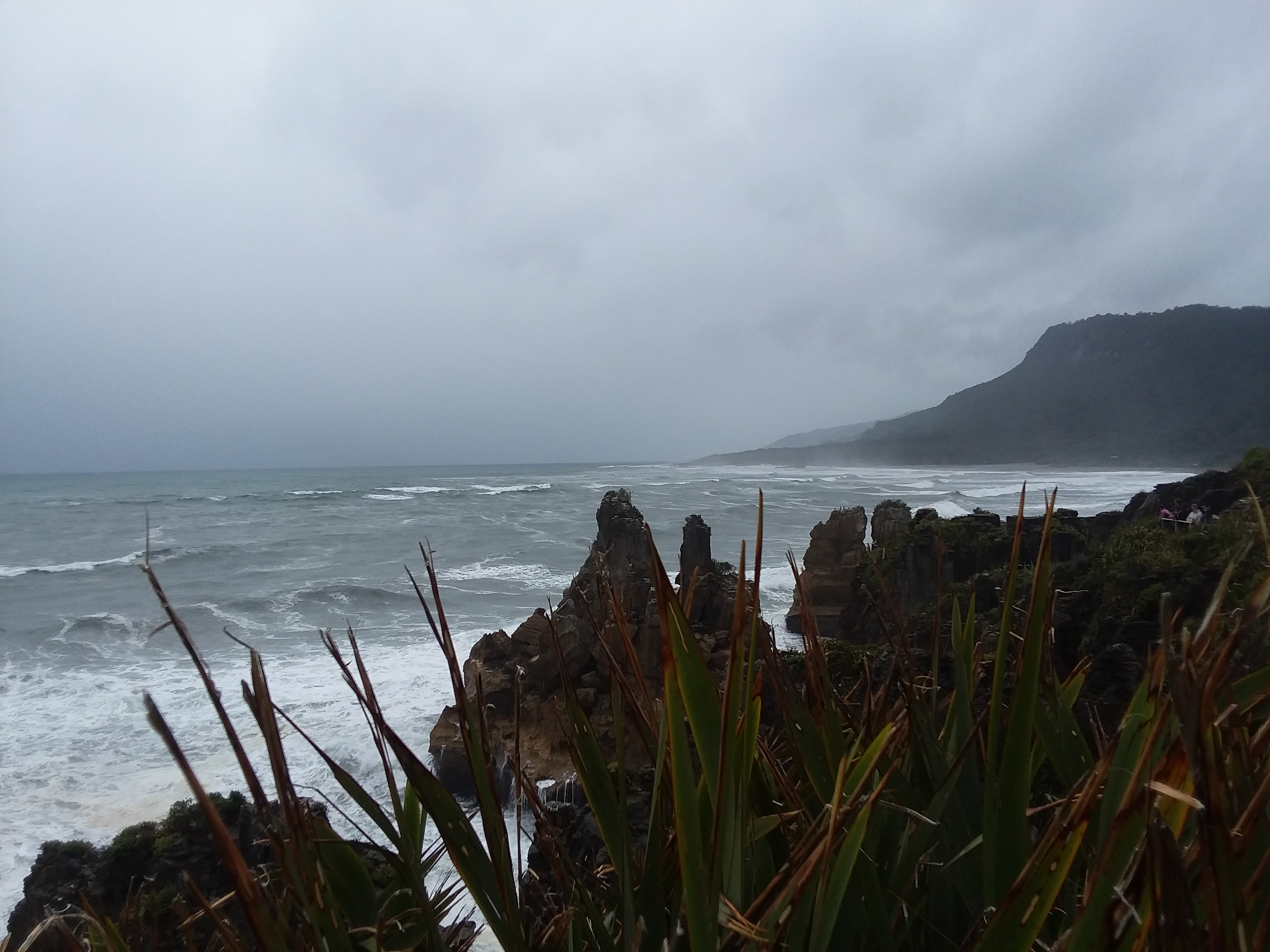
We are on the West Coast of New Zealand’s South Island. It’s an off-grid shack I booked months ago because it was cheap and on the beach and just off the winding remote highway that I used to drive down once a month for work, wondering who lived in these weather-beaten cribs that have been here for generations, just barely enough shelter from the tides, storms and sand flies. For these first two nights, it belongs to no one but us.

It’s a perfect crash pad after four hours of buses, Ubers, check-in lines, a bad airport bar, then finally an 11-hour flight to Fiji, a 3-hour layover, than a 5-hour flight to Christchurch, bio-security checks, then finally, a 5-hour car journey from the East Coast of the South Island, to the West Coast.

I was emotional just walking out of the airport in the sunlight to collect our car. Then there was the long last stretch: a drive through mountains, over a hundred rivers that my husband craned his head to look at as we passed over, bright red rata vines in the bush around us, waterfalls exploding down, and finally that first glimpse of the Tasman Sea as we dipped down to the mouth of the Grey River that used to make my heart explode.

John has his fly rod and back-country pass. I have no agenda for our three weeks in New Zealand, except to follow him to rivers around the South Island, swim, eat lots of ice cream, and re-visit the haunts that shaped me in my 20s and early 30s when I lived here, in my father’s homeland.

It’s strange to think that a week ago I needed snow boots to walk to the car in our yard in Montana. I don’t need shoes to do anything here. John can’t get over that on a sunny day, entire families will march barefoot through the supermarket to do their shopping.

I have the same wonder – a returner’s wonder, I’m calling it. It’s about all those things you took for granted and forgot when you left a place. It’s been four years since I left New Zealand; seven years since I’ve been on this coast.

Being Here

Note for travelers, both returners and first-timers: I booked our first two nights in NZ at this rental and I’d highly recommend it – but there are about ten more that I’d love to book in the future,  up and down the Tasman, many for under $150. My almost rental was here – please tell me this doesn’t make you want to book a ticket to the South Island just to sit in this bathtub and watch penguins. Some other picturesque options near Punakaiki: A beachfront cottage for about $115. This off-grid sea shack tucked away into native bush is rentable for around $75. Stock up on groceries – we brought coffee, fruit and yogurt, lamb chops, fresh corn, salad, wine, beer and venison sausages for a barbecue on our second night – in either Greymouth (about an hour and a half away) if you are coming from the south, like we did. Westport would be the nearest hub north of this spot, also just under two hours.

Also, if you’re looking for a good read to take along with you, pick up Eleanor Catton’s The Luminaries. She’s the youngest author to win the Man Booker Prize and it takes place just two hours south of here, in Hokitika. It’s crazy and beautiful and a pretty beefy, tough 826-page novel. But it suits this place.


Going home at 40

This morning I went for a run, sun on my bare shoulders, the smell of damp eucalyptus trees around me, the sound of crows picking off the last of the walnuts in the branches above.

All around me is the neighborhood I grew up in. My feet crush shriveled olives, persimmons and walnut tree leaves as I move. It is winter and 75 degrees outside before noon.

I used to always want to arrive home in California with my life full of sureness. To appear together, visibly going somewhere. There have been years when it’s felt like I’ve been obedient to how my life is supposed to look. Most of the time though, instead of a triumphant return, it’s a collapse. Those are the years when I’ve loved this place the most.

When I go on these runs it is like swimming blind through memory lanes. I drift in and out of time lines. I’m too old to be nostalgic for my childhood here. Instead, there’s this tenderness for the long stretches of time I spent here in my 20s and 30s, usually arriving broken and beaten up by life, sullen, ready to sleep for 16 hours straight, then sit in the hot tub and grumpily drink coffee brewed hours before, when my parents first got up that morning.

Different scenes will come back to me at different times, and hardly ever chronologically. When I sit at the Corner Coffeehouse and eat gelato, I remember pacing the sidewalk outside, walking back and forth during a phone interview for a job in northern Montana that I didn’t take. Then hanging up and having that feeling that I could go anywhere I wanted when I was 36.

I drop off our rent check in the mail box outside the Los Olivos Post Office and walk past the gate to local hotel that we used to climb over to swim in the pool, a few months after I turned 33 and thought that life was all downhill at that point for me.

There were the hours I spent sitting back in a backyard chair made out of a wine barrel, tasting syrah from the hills around me, mourning the loss of the redneck ranching town that this place used to be – but simultaneously realizing that I was totally comfortable enjoying it’s trendiness as the new Napa. That I had changed just as much as this town of 900 people had. It was impossible not to alter, to adapt somehow, in order to survive and grow.

I drive with my mom to the next town over, and I think of myself, biking in flip flops and shorts and gas station sunglasses, to get peaches and nectarines from the farmers’ market on Tuesday afternoons, having just come from winter in the southern hemisphere at 28, uncaring that I was getting passed by serious cyclists, in proper, padded, cycling shorts.

This week I am back for the first time in this new decade of my life. My husband and I are here for five days, to drop off our truck in my parents’ backyard while we go overseas. Winter in Montana feels like this Narnia-esque dream we’ve woken up from. In the afternoons I walk outside barefoot and lace up my running shoes in the driveway. Before I leave I see John helping my dad rake leaves in the front yard. Later they will watch football in the garage. John and I are going over to our friends’ house tonight to barbecue in their back yard and drink cocktails at their kitchen island, surrounded by their girls, who I’ve known since their infancy.

Maybe in another 20 years, I’ll remember the ordinariness of the visiting times just like this one. When everyone we love is just down the street, or a phone call away.

Sometimes it takes a run through the neighborhood to bring it all home. I’m older now, so I feel released from having it all together when I return. Instead, this is what I wrap my mind around: The sun is out. I’m able to run. My lungs inhale and exhale air. There is my husband and dad raking leaves, with a game on in the garage and my mother cleaning out the filing cabinets in the office while listening to an audio book. Later, there is dinner with old friends just down the road.

That is as together as I need to be.

New shores

Philipsburg, Montana is hundreds of miles behind us as we drive, wipers brushing off the driving rain, sports radio commentary analyzing last night’s Saints vs. Panthers game on, as we hurtle towards California in a muddy Toyota Tundra.

Winter as we know it is also behind us. Today is Nevada. This is high desert grasses, bail bond billboards, isolated agricultural towns fronted by blinking lights advertising 24-hour casinos. We pass prisons. My eyes follow white, bare houses on tussock hills, then stay on the trains that smoothly parallel us as we move alongside lines of oil tankers. We are all going west.

There is no snow here. When we stop at gas stations and get out of the car, there is a smell of damp earth, shrubs and trees, all the earthiness that gets buried under white in Montana for most of the year.

We’ve been working steadily from mid-December to prepare for this getaway, and yet it was nine hours into this road trip before I felt the cut and release that always comes when I leave a place. I feel that flick of addiction. There’s a reason that people stay on the move all their lives.

Is it change?  A fresh start? New territory, maybe, or a return to a piece of ourselves that gets forgotten or put on the back burner until life slows down a little bit. And out here it does. Suddenly there is nothing but empty hours to let our minds churn things over, to take an idea and run with it.

Such as: getting out at the gas station in Elko, I think about what it would be like to live here. To work at a hotel reception, or the blackjack tables, or the supermarket checkout. Then there is this playful, new fear – every time our GPS tells us the fastest route would be to take this narrow dirt road on the left, just up ahead –  that surely by now there is a serial killer tech-savvy enough to lure a road-weary couple right over a cattle guard and onto his compound, where a gate will clang shut behind us.

We pass by oil fields, steam springing up, and I think back to a short story I read in my early 20s, about a woman who takes a job in a place just like this. I remember how that story made an impression on me. It was lonely and had a sense of bridges that had burned behind this woman. The theme was isolation. But I remember it was also a story about escape. She had survived something. As we drove, I just couldn’t remember what that something was. Or what the story was called. Or who the author was. There is no cell reception or coverage out here, so I can’t even do a Google search. So I sit back, trying to piece that tale back together from memory.

That’s what this time is for, hours and hours on the road, relishing in the rarity of being bored and seeing where that goes.

In another five hours we will be at the ocean. In seven hours we will pull into the gravel of my parents’ driveway where a porch light will be on, and bowls of ice cream will be brought to us by the fire. In the morning, I’ll be able to go for a run without putting on snow boots and three layers. I can slip on running shoes.

Even writing that last paragraph reminds me how wealthy I am in time. When it passes this slowly, I can’t help but be aware of it slipping by.

And this is just the first leg of a five-week journey. We are going west and south, and then really, really south. Southern hemisphere south.

But before all that, there is this. A slow re-awakening to a world outside of winter.

So this is Winter

From my bed it is a perfect Montana scene.

My pillows are propped behind me and knees drawn up so this laptop is at the right angle to type away. And to my left, out a window still streaked with dog slobber, is my husband’s camper, tarped up in blue and frosted with last night’s snowfall. Beyond this are roofs with chimneys blowing out tufts of smoke, and then hills with trees heavy and dripping under drifts.
I’m well into my fourth winter in Montana. I forget how this turns my life into a series of activities done in slow motion. Everything – from walking to the car, to driving to work, to clothing myself every time I leave my house – is like I am moving under water. I feel like the trees outside the window, sagging under their weight. Everything takes twice is long and the window of daylight seems like little more than a sliver before the curtains fall back and it is dark again.

In other years, I’ve raged against the dying of the light.

This year, I’m aligned with this season arriving.
Our worlds are smaller. Travel on some days is ill-advised or impossible. Taking the dog out for a walk in snow boots, gloves, beanie, and sometimes snow pants is a long labor each time and each time we return, even from a walk around town, we blast through the front door, white flakes swirling around and off us, exposed hair frozen stiff, like we’ve just returned from an expedition to Antarctica. We put the kettle on, turn on the heater and it crackles to life and then we collapse on the couch.
When I first moved into this 1880s house, I put up a map of the world and blown up pictures of places that I have loved. They remind me of wilder, rockier times as I lie there on the couch, as the heater roars, still half in my snowy day clothes and I look up and around me. There’s a photo of a fire on a beach; a full moon over a lonely lagoon; a wall of tiles in Lisbon; a wave crashing on a Cornwall shore. But right now, stepping into this weather-beaten home with a sagging deck backed by a camper covered by a blue tarp flapping in the wind, this beats out all those places for me. Like that beach at night, lit up by a driftwood fire, or that neighborhood in Portugal that I wandered around in seven years ago, or that full moon I saw on a night run near a lagoon on the edge of rainforest, this is where I am meant to be.
Outside in our yard, the hammock has been folded up and the trees that shone green in June are a skeletal outline in the porch light as evening comes.
Maybe that isn’t a shot for a calendar. But it’s winter and it’s home and I’m grateful that it’s closing in around me.

River widows

In this part of Montana, there is a decent percentage of women who spend a portion of the summers on their own, temporary widows to the rivers, Alaskan mines and an awakening fire season.  I only realize this when I travel somewhere else – back to visit my family in California for a weekend most recently where most have a Monday to Friday, 9 to 5 grind – and explain how work is going for my husband.
Work as a fly-fishing guide is great for him. Which means that I don’t really see that much of John right now and our life is absent of routine. In Montana, this is the norm. In California, it’s like explaining that I’m married to a sea captain.
These are the months when John could be guiding on Rock Creek one day, then be on the Big Hole for the next three, followed by a week on the Madison or Gallatin. Life for both of us is week to week, with no set schedules. But I’m finding that I like the rhythm of these long summer days that have become a re-visitation to my spinster self. There is no real household to keep in order, except for the dog, so I am lucky that way. Marriage may challenge  me to be better at sharing (though I learned early on that the supersized re-sealable bags of veggie burgers in the freezer are brilliant hiding spots for Ben and Jerry ice cream pints) but these are the months when I can regress  without guilt. Because the house, once more, is all mine again.
The fly-tying station set up at our kitchen table through the spring has been packed away. When I get up in the morning, I have a clean surface or a vase of flowers that I pass by as I pad across the wooden floor to the kitchen and sleepily turn on the coffee, opening the door to let the dog out. Everything is arranged exactly how I like it as I’m waking up in our home. I don’t have to justify playing Sade’s Greatest Hits as I write in my PJs on the couch until noon. 
After living and working together through the winter and spring, there is something about having this time to unabashedly do what we love in our separate spheres for a few days at a time. We are both independent people and I think it is good for us to remember what it is like to miss each other. Because I do love these chunks of time right now to myself, when I can watch movies that have subtitles in the evening with the fan flowing and the last beer in the fridge. I can make plans and then change them. I can start a project on the kitchen table, then leave it there overnight to continue with the following day and not be apologetic.
I can also pack up the dog and go find my husband on one of the beautiful rivers where he spends his days or meet him in Missoula or Bozeman for a night and maybe go hear a band or go out for drinks somewhere with a garden patio and strung lights (I demand places like this when we meet up for an outing in a city). There is a lot of freedom in this time. The summer feels long, and not even half-over, and there is that great July sense of long hours of sunlight, aching feet, and cool rivers to soak our soles and talk about what we are barbequing that night.
That’s about as far ahead as our planning stretches. I wouldn’t have it any other way right now.

A quest for rest and Montana mermaids

Nothing breaks the hysteria of spring fever like a road trip to a tiki bar, in the middle of the northern Great Plains, complete with a Mai Tai and mermaids blowing kisses from the blue waters of the O’Haire Motor Inn pool.
There were three of us women who would usually be working in the evenings together. Filled up with tales of the Sip n Dip Lounge, dubbed the number one bar in the country worth flying for by GQ in 2003, we decided that last Wednesday was our moment. We all had the night off – probably the last time this would happen until the end of summer. And so began an overnight pilgrimage from Philipsburg to Great Falls to see the landlocked mermaids for ourselves.
After a long, ocean-less winter, I don’t know if there is anything that makes me feel more like myself again than driving off in a direction I’ve never been before. With Helmville behind us, and hours to get to our final destination – where the only plans we had were to order drinks with maraschino cherries stabbed by tiny umbrellas – there was that rare chunk of time when you can just cruise with your feet on the dashboard and watch a fresh landscape unfold as you listen to a podcasts.
We stopped for coffee. We stopped for fudge samples and beef jerky. We listened to NPR stories that featured themes revolving around the five senses. Leaving Lincoln, we drove past a shiny structure on our left, barely visible through the trees and spotted a sign for Blackfoot Pathways: Sculpture in the Wild. The car reversed and we entered the circular driveway for an exhibition that we hadn’t heard of, featuring international artists creating pieces inspired by the landscape and history of the Blackfoot Valley. We started off in a cluster, but broke off to wander down the path through the woods on our own, stopping and taking all the time we needed to pause in each clearing, or just keeping walking. I had left all electronics in the car – I only knew it was after 2 p.m. but sometime before 5. Sitting on a bench in the quiet afternoon, I realized how much I missed being unhurried. I couldn’t remember the last time I wasn’t aware of time.
A few hours later, the mermaids had just descended into the pool when we arrived and took a shell-shaped padded booth in the back of the Sip n’ Dip, watching the women in goggles and home-made fish tails swirl around in the glass behind rows of liquor bottles. One of us had brought the complimentary rubber ducky from our hotel room to be signed by Piano Pat, when she went on break from playing songs like “I Love this Bar” and “Sweet Caroline,” setting the scene at the start of the night as her fingers glided over the keyboard with her spoken intro: “Great Falls … Wednesday night …”
It’s hard to say who is more famous here – the mermaids, who attracted a guest appearance from Daryl Hannah in 2004 to reprise her role from the 1984 movie “Splash” – or Piano Pat Sponheim, who was a divorced single mother of three at age 28 when she started playing evenings in 1963, while still holding a job as a medical transcriptionist. Everyone around seems to know the story about Pat  – and  it’s as fun to see her live, singing Elvis, while I’m sipping a Blue Hawaiian as it is to see her crooning on a segment of NBC. By midnight my eyelids had started to droop and I was ill on sweet alcohol, but I still had that weird satisfaction of making it to a place that had always seemed like one of those bucket list items that just needed to get done.
Now that I’ve been christened by Sip n Dip mermaids, a few drinks the color of windshield wiper fluid, and a night of listening to Pat from a padded booth the shape of a sea shell, I remember how fun it is to think you know a corner of the country pretty well. Then you take a back road one Wednesday afternoon, allow yourself a few detours, and end up in a motor inn with a complimentary rubber ducky for a night. And you realize that you’re just scratching the surface.

A creek, a raft, tequila, Ryan Bingham, a happy dog and other necessities for a Montana staycation


If you live in Montana, nothing feels quite like spring like that first float down a river with the sun on your face. It was a Wednesday – my shoulders were warm under my jacket, and in another spring first, I was wearing sunglasses, watching the dry fly my husband had tied at our kitchen table a few days before catch the current and drift along beside our raft. Best of all: This abundance was a 35 minute drive from our front yard.
This was far from the original plan of how this week would be spent. We were supposed to be on the Smith River, braving the elements with three of John’s groomsmen from our wedding five months ago. One by one through March, each of them had to pull out from the five-day trip. John and I began making plans to do it on our own – but in the end we were foiled by finances (April is also the tax crunch month), my panic about the lack of time to work on projects with rapidly approaching deadlines, and, of course, the never-ending question of what to do with our dog, Gabe, who is improving month by month, but still has anxiety quirks that make him a liability as a week-long houseguest for friends and family. Sending him to a kennel for five days would be expensive and it would likely undo the trust we’d been building with him since we brought him home from Missoula Animal Control in December.
The solution: a short drive to the $20 forestry cabin that allows dogs, a maiden voyage of a friend’s raft that has been parked on our lawn for ten months, pork from our freezer, a gifted bottle of whisky, supplies for margaritas, cards for poker, and as always, stacks of books and playlists of favorite albums.
So I’ve had some great memories walking through the doors of beautiful hotel rooms. There is that euphoria over the view, the sense of leaving responsibilities and stresses at the door, and little luxuries like fluffy spa bathrobes and perfect white king beds with the sound of the waves crashing on the beach below. But it’s funny how walking back to a bare bones one-room cabin at dusk, lit by a lantern, candles and the glow of a potbelly stove; smelling pork loins grilling on the coals in the fire pit outside and hearing Ryan Bingham’s Fear and Saturday Night on the stereo as I’m greeted at the door by a dog who seems born to live in the woods, evokes a feeling that has redefined “vacation” for me.
The mornings had late starts, with coffee percolating. Gabe and I let John explore Rock Creek on his own that first day, as we dropped John and the raft off, went back for a second pot of coffee and sat in the sun, then shuttled down the creek later in the afternoon to pick him up after wandering around the creek banks on our own. On Wednesday, we came back to Philipsburg to pick up my car and leave Gabe at the house – he hasn’t proven himself as a raft dog yet – then floated Rock Creek on our own. I realized I hadn’t been on a river since we floated the Bitterroot last August. I caught a few fish, lost a few too, but spent much of that late afternoon watching the sky and the cliffs that rose up over the creek.
It was a beautiful and quiet float, the definition of a lazy afternoon as the world around us drifted by. The light began to lower and there was a sharp chill out as we reached the bridge where my car was parked. We tied the raft to a tree on the bank and drove back to the truck and trailer, spotting a male moose in the creek on our left and slowing down to watch his deceptively slow amble through the reeds. We were quiet and suddenly exhausted as we continued along Rock Creek Road, in our dusty boots, our jackets and hair smelling of campfire and bacon fumes.
Maybe it wasn’t the wildness of the Smith. But it was 52 hours away in our backyard that made us remember how much beauty and adventure we have right here around us.

Commuting

Last week I realized that driving with my husband to work in the evenings has become my favorite block of time this winter.
I didn’t think this would be so in January. When two people live together and also work evenings together in a bar and dining room (our workplace is The Ranch at Rock Creek – and yes – this area is as gorgeous as it appears on their website), there’s always that chance that one, or both of us, will feel like we’re in each other’s spheres a little too much.
During the day, it can feel like a hustle from the time we wake up and the hot water kettle starts to boil. Both of us have projects we’re juggling. Each morning is different, depending on what is most immediate. No matter what I’m working on, I always feel a little haunted by the hundred other things that also need to be prioritized. I overestimate how much I can complete, then I get frustrated  with myself when 2 p.m. rolls around. I get dressed for work, dogged by the long list that hasn’t been checked off, put on my outside boots and cram my makeup bag into my oversize work lapel that seems to be ballooning more and more each week with day planners and random bits and pieces of projects that need to be filed, and grumpily track John to the truck, feeling like a mess.
But I’ve found that something happens when I shut the passenger door and we start rolling out of town and take a left at the highway. Philipsburg disappears behind us and we are in ranch land. The houses become smaller. Right at the place where I start to lose cell phone reception, all those pressing actions that need my attention, start to feel just a fraction less important.
When it has been snowing, we take our time, both of us focused only on the drifts that blow in gusts across the road as we slow to a crawl. The barbed wire fences fly past us. I’ll watch the cattle cluster together, their dark forms sometimes the only way to orientate distance in the bare, white hills that would lose dimension without these markers. I’ll see that one tiny, structure, still there after decades, maybe a century, all by itself in all that snow as it passes my window and wonder how it is still upright. It looks so small in this landscape – something about it always makes me want to turn the heater up a few degrees.
Sometimes we listen to a podcast as we drive and watch the scenery around us: the same mountain peaks that are perfectly framed over our kitchen sink window loom on our left; on the right, the tree line starts to meet us as we come around the corner and drop back down into the woods. Most of the time it’s the same country music station that fades in and out of reception as we talk. I’ll peel an orange that I’ve brought with me and hand half to John. When I’m done putting on mascara and put my makeup bag away – always before the road gets bumpy – he’ll take my hand and we’ll just drive in silence.
As the weeks have become months, the snow has receded. When we wake up and the hot water kettle whistles, I’ll often open a window instead of turning on the heater. There is grass under my boots instead of snow when I walk to the truck behind John. Beyond the fence lines as we drive, newborn calves rise shakily to their feet. The slushy roads that required four-wheel drive at this time last month, now have dust rising up in clouds behind us. It is spring.
And with this new season are the strange weather patterns that disorientate me. Hours after driving that last stretch of dirt road to work, I’ll look out across the basin to see what looks to be even more dust coming my way. Then I realize it’s a rogue snow flurry, like the last death rattles of winter.
This is my final week commuting with my husband, as he prepares for his season as a fly-fishing outfitter. April is a gentle start for him, but once the season gets going, we will be like two ships passing until late September.
Maybe a shared commute is the most ordinary of half hours. But I’m realizing it’s one of the winter routines that I will miss.

[A version of this column appeared in a March edition of the Philipsburg Mail]

21 years ago

Twenty-one years ago, I got a job washing dishes in a hotel on the Croatian coast, in a small resort town called Crikvenica.
It was 1996; I was 18 and still in the first six months of living away from my hometown in Santa Barbara county where I had spent all but three years of my life. I could drive, do my own laundry, load a dishwasher, get myself to class and back, and hold a part-time job at a local coffeehouse on Friday nights. When I graduated high school, I was finally trusted to return home safe from a three-day road trip up to San Francisco with my best friend, as long as we stayed a pre-approved lodging. In other words, traveling Europe for the first time was also combined with just learning how to live independently.
And it worked out, to the relief, I’m sure, of my parents, who waited on calls from payphones and postcards week to week. I made friends and bought Hungarian and Czech language books while traveling through Eastern Europe with a group of Canadians I had met in Austria. When they easily got visas to Turkey while my status had a delay, I turned around and took advantage of the month-long train pass that also, magically, covered all rail travel in Great Britain, where transport was most expensive. I spent New Year’s at a youth hostel in Cornwall, going on my first hike by myself. The first hotel room I ever had on my own was in Paris. I was surviving, I would tell myself, watching the buildings of cities I spent my senior year of high school dreaming of visiting glide past my window on the trains that became like second homes that month. I felt that if Europe was a test on entering adulthood, I was acing it.
Until I arrived in Crikvenica. It’s pronounced “Tza-kren-itz-ah” – and it was my first true settling point in Europe. The job was for three months in a hotel that had been bought by a church group, who were using it to temporarily house refugees from the Balkan war.
It was February, dark and wintry. The common language was Russian. The hotel had balconies that looked out to the sea but the building itself had a utilitarian Soviet Bloc feel to it. Until this time, I had only been around kids around my own age who were also traveling on their own for the first time, all of us from countries where English was the first language. Most of us were also from the same socio-economic backgrounds, which I would describe as above comfortable.
I was aware of the world from books and the evening news, but I didn’t understand how people who have been through trauma move forward. It was all women in the kitchen around me who were chopping and cooking– none spoke English. The hotel was run by former refugees, serving other refugees from Serbia, Bosnia and Montenegro, who came with their families to have a two-week break from the camps they had been placed in, some for years. The hotel offered hot meals, space and counselling services. While the war had ended with a peace agreement two months before, an estimated 2.2 million people had been displaced by the armed conflict that had killed about 100,000 people. In the kitchen, my favorite was Marta, who was thin and tall with blonde hair, always tied back in a high, tight ponytail. She wore boots, bracelets that jangled around her wrists and a thick jacket with a fur-lined hood that she would hang up in a hook outside the kitchen, before slipping on her apron. She would always bring a radio that she would turn on and place above the sink and try and get the older women to dance with her. To me she was sophisticated and intimidating. Marta never spoke to me. Later, someone told me Marta fled with her family from Sarajevo during the siege, by escaping through the sewer system that finally led them to the 800-foot underground tunnel out of the city. The siege had been ongoing since 1992; towards the end, they’d been living on flour and water mixed together. I’d watch her sometimes while I was washing dishes and try to imagine all this happening to her, and I couldn’t reconcile it.
At some point in my time at the hotel, someone decided that I should see the war zones myself. These memories are so absurd and surreal, I had to drag a photo album down from a top shelf tonight to make sure I didn’t make it all up. I was sent with three other Canadian guys, who had come to help with maintenance, on a 12-hour bus trip to a church in Mostar, in southern Bosnia and Herzegovina, where gunfire could still be heard when were dropped off near the city square. We asked to use the phone at a shoe store that existed in a shell of a bombed building. We dialled the number given to us. A friend of a friend who spoke English picked us up and gave us what can only be described as a tour of everything that had been destroyed. We stayed with him for four days and each day was a road trip to a different razed town or city. Often we were escorted by soldiers who walked along with us, smoking and pointing out where land mines had been identified. There are times when I think back and wonder if I’ve confused all those memories with war movies I’ve seen. I look at the photos I took – a tank on a dirt road stopping for cows; piles of books in a shelled school, with holes in the wall that looked out to a landscape of levelled buildings – and clearly it wasn’t.
If anyone in the hotel kitchen needed me to do something, they’d call out “Hey Santa Barbara” because they couldn’t pronounce my name, but they recognized where I was from immediately. The soap opera by the same name had been cancelled in the U.S. for years. But every day at 4 p.m., the television room filled up with women in bathrobes and slippers who had just showered after work and settled into their favorite chairs to watch characters named “Eden” and “Flame” live their lives in the gilded world that I’m sure many assumed I had come from. They were never unkind to me – at the end of my time, one of them offered to read my future in cooled coffee grains from the stove-top percolator – but nothing about me made them feel like I knew what they had been through.
And I didn’t. I didn’t understand war and how healing happens. I was young and I thought it would be dramatic and obvious, like it was in the movies. Not dancing in a kitchen or taking hot showers and curling up in a chair to watch a show that makes to happy for a little while. I toured the bombed towns without connecting this to anyone’s history, especially the women I worked with. It felt like a movie set to me. When I look back at that first February abroad, I think about how lonely I was. It was the first time where I was in a place that was so foreign to me.
Spring came and I went on to Italy, then England and Ireland and finally back to California, just in time for my 19th birthday. I returned to friends and family who were just like me. Life in Santa Barbara went back to being easy and comfortable for awhile. I always thought I would go back to Crikvenica someday, maybe in the summer. But I didn’t and it has became one of those places that end up in a photo album that I pull out every few years, when I try to trace how I’ve become who I am now, at 39. It’s like following breadcrumbs. Why do I think what I think? Why does this make me angry? It’s hard to see when I am being shaped by a place, while I am there. Even for three months. But years later, when I look through photos of towns like Crikvenica – places that must have impacted me in some way that I didn’t realize at the time- and who I am now makes more sense to me.